Posts

Rupert Sheldrake: Telephone Telepathy

Rupert's genius is developing simple, scientifically sound ways of demonstrating psi phenomena. Telephone telepathy is one of my favorites, and this video is a great way of showing how the test works, and a glimpse at the results.

ESP Trainer by Russell Targ

See this page for information about Russell Targ’s ESP Trainer app for the iPhone. As it says on Russell’s webpage, In a year long NASA program with 145 subjects (under Contract 953653 NAS7-100) many were able to significantly improve their scores. Four of the subjects improved their scores at the hundred-to-one level or better. This approach has been used with surprising success on Wall Street. But of course, past results are no guarantee of future performance. Because you are learning a new skill, slower is better than faster. If you find yourself frequently scoring 12 or more, write to the developer: Contact Russell Targ

Dynamic entanglement in living systems

As I discussed in Entangled Minds: From the November 3, 2009 issue of Scientific American Wouldn’t it be nice to be an electron? Then you, too, could take advantage of the marvels of quantum mechanics, such as being in two places at once—very handy for juggling the competing demands of modern life. Alas, physicists have long spoiled the fantasy by saying that quantum mechanics applies only to microscopic things. Yet that is a myth. In the modern view that has gained traction in the past decade, you don’t see quantum effects in everyday life not because you are big, per se, but because those effects are camouflaged by their own sheer complexity. They are there if you know how to look, and physicists have been realizing that they show up in the macroscopic world more than they thought. “The standard arguments may be too pessimistic as to the survival of quantum effects,” says Nobel laureate physicist Anthony Leggett of the University of Illinois. ... This work suggests that, contrary to ...
Big Bang Theory

This clip from the TV show, The Big Bang Theory , could be a documentary of my life, although as an empiricist I spend somewhat more time collecting and analyzing data, and then staring at computers, rather than staring at equations on whiteboards. But I can easily stare at an analysis for a few days too, so this scene isn't all that far off.

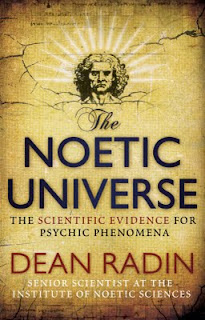
The Noetic Universe

Image
This is the cover of a reprint of The Conscious Universe , to be published in the UK soon. I wrote a new Preface for this book, which is aimed to ride the wave of interest in noetic science as a result of Dan Brown's The Lost Symbol . Publishers often look for books that accommodate the public's request for more information on certain topics, and that's what happened here. I approved the publisher's recommendation for the revised title and new book jacket (which I like much more than the original jacket with the silly floating spoon!).

Quantum Mechanics and Consciousness

This is an excellent video talk on quantum mechanics and consciousness, by astrophysicist Bernard Haisch, given at the Society for Scientific Exploration meeting in July 2009 .

Mind modulated randomness?

Exploratory Evidence for Correlations Between Entrained Mental Coherence and Random Physical Systems Journal of Scientific Exploration , Vol 23 (3), 2009 DEAN RADIN Institute of Noetic Sciences F. HOLMES ATWATER The Monroe Institute Abstract - An experiment tested whether mental coherence entrained in groups would affect sequences of data generated by truly random number generators (RNGs) in the vicinity of those groups. Coherence was entrained by having groups listen to a prescribed series of binaural-beat rhythms during a 6-day workshop. Two RNGs based on electronic noise and one on radioactive decay latencies were located in the building where the workshops took place. Random data were continually collected from these RNGs during 14 workshops. As controls, the same RNGs generated data in the same locations and times but during 8 weeks when no workshops took place. Other RNGs in two distant locations were run as additional controls. An exploratory hypothesis predicted that fluctuati...